

A single padel court booked at 150–300 SAR per hour, with four players sharing the cost, can generate a meaningful monthly return for club owners once demand settles into a steady rhythm. What most first-time investors underestimate, though, is how much that return depends on a single early decision: the quality of the Sports Field Turf and the structural work beneath it. Court dimensions, glass thickness, lighting, and the turf system together decide whether players keep coming back or whether the facility struggles with slow ball speed, poor drainage, or early wear within a year or two. This guide walks through what a properly built padel court actually requires, from official measurements to realistic cost drivers in the Saudi market.
What Are the Official Padel Court Dimensions?
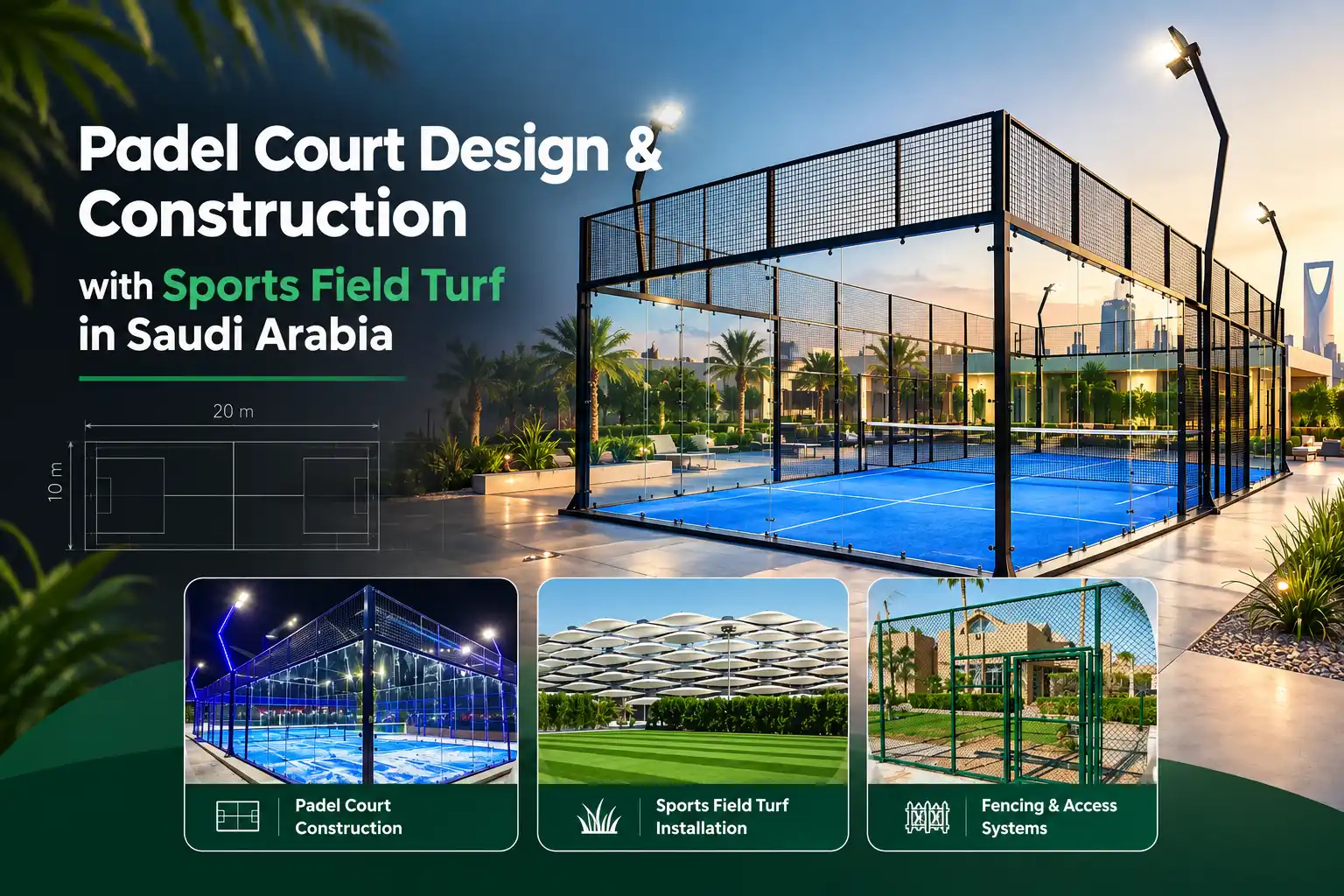
A regulation padel court measures 20 by 10 meters, enclosed by tempered glass panels and metal mesh, with a tolerance of no more than 0.5% under FIP rules.
These figures are not cosmetic details they determine whether the court can host sanctioned matches and whether ball rebound behaves predictably. The table below summarizes the core specifications any contractor should follow before construction begins.
| Element | Standard Specification |
| Playing surface | 20 × 10 m (200 m²) |
| Back wall height | 3 to 4 meters |
| Net height | 88 cm at center, 92 cm at posts |
| Tempered glass thickness | 10 to 12 mm |
| Lighting for recreational play | 400 lux minimum |
| Lighting for club-level play | 600 lux or higher |
| Clear ceiling height (indoor courts) | At least 6 meters |
Beyond these numbers, a safety run-off zone of roughly two meters around the perimeter allows players to retrieve balls without colliding with fencing a detail that is easy to overlook when sizing the plot of land before the project even starts. Orientation matters too: aligning the court’s long axis north–south, where the site allows, reduces direct sun glare for players during peak afternoon hours.
How Is a Professional Padel Court Built, Step by Step?
Building a padel court is a sequenced construction process, and a weak link at any stage affects the finished playing surface:
- Site survey and measurement assessing ground condition and drainage slope before any design is finalized.
- Base preparation excavation, leveling, and pouring a concrete or asphalt base with precise drainage gradients to prevent water pooling.
- Steel structure installation erecting the posts and frame that will carry the glass and mesh at the correct heights.
- Glass and mesh fitting mounting tempered glass panels and steel mesh with the accuracy needed for consistent ball rebound.
- Sports Field Turf installation laying the padel-specific turf system and compacting fine silica sand into the fibers to control ball slide and grip.
- Line marking painting the 5 cm-wide service and center lines to exact tolerances.
- Net and lighting setup fitting the net at regulation height and positioning LED fixtures to meet the required lux level.
- Final inspection and handover testing ball bounce, drainage, and lighting uniformity before the court goes into use.
If you’re planning a padel court project, even a single court, get a free quote for your padel court project from House of Quality via WhatsApp before committing to any construction step.
Which Sports Field Turf Types Work Best for Padel Courts?
The turf itself is one of the biggest factors in how a padel court actually plays, directly affecting ball speed, rebound, and how comfortable players feel during quick lateral movement.
| Turf Type | Description | Best Suited For |
| Monofilament turf | Smooth, durable fibers that closely mimic natural grass | Professional and club-level courts |
| Fibrillated turf | Interwoven fibers offering extra underfoot stability | Recreational and mid-use courts |
| Sand-infilled turf | Fine silica sand packed between fibers to regulate ball slide | All outdoor padel court types |
Pile height on padel courts typically runs between 10 and 20 millimeters, noticeably shorter than turf used for home gardens, since the priority here is controlling play speed rather than pure visual appearance. You can compare density and warranty options across House of Quality’s Sports Field Turf range before finalizing a decision, and for facilities that also want green accents on surrounding walls, the broader Artificial Grass collection covers wall and landscaping options as well.
What Does It Cost to Build a Padel Court in Saudi Arabia?
Cost varies by court size and the materials chosen, and typically covers the turf system, mesh and glass structure, lighting, and civil works a fixed number isn’t realistic without an actual site visit.
The table below shows the relative weight each component tends to carry within a padel court budget:
| Cost Component | Typical Budget Weight |
| Structural frame (glass, steel, mesh) | Highest |
| Sports Field Turf and sand infill | Medium to high |
| LED lighting system | Medium |
| Civil works (excavation, drainage, base) | Medium |
| Installation labor | Varies by court size |
The main variables that push cost up or down include full panoramic glass versus a partially meshed design, the lighting tier required (recreational versus club-level), and how accessible the plot is for excavation and material delivery. For a closer look at turf pricing specifically, see the Artificial Grass Price Per Meter in Saudi Arabia guide, which breaks down how thickness and density affect price per square meter.
In practice, most investors are better served by collecting two or three detailed quotes before committing to a single contractor, making sure each proposal specifies the exact glass and turf grade since headline price differences usually come down to material quality, not just contractor margin.
Why Choose House of Quality for Your Padel Court Project?
Many sports facility owners prefer working with a single supplier that handles both materials and installation, rather than coordinating several vendors separately. At House of Quality, pricing includes a free site visit and measurement before any agreement is signed, along with a dedicated installation team that stays on the project from excavation through final handover. The company also backs its Sports Field Turf with a genuine warranty against heat, moisture, and UV wear a meaningful factor given how much of the Saudi calendar runs hot plus ongoing customer support throughout the week for anything that comes up after installation.
You can browse the current padel and sports court range to see available options, or get a free quote for your padel court project from House of Quality directly before the next booking season picks up.
Frequently Asked Questions About Padel Courts
How much does it cost to build a padel court in Saudi Arabia?
Cost varies by court size and materials used, covering the turf, mesh, lighting, and structural work, so an accurate figure depends on a site visit.
What is the standard size of a padel court?
The playing surface measures 200 square meters (20 × 10 meters), plus additional space around the court for player safety.
Can a residential or commercial plot be converted into a padel court?
Yes, provided the plot fits the regulation dimensions plus the safety run-off zone, and the ground allows for proper excavation and drainage work.
How long does it take to build a padel court from scratch?
Timelines vary with project size and site complexity, and are confirmed after a site survey and delivery schedule are set.
Do indoor and outdoor padel courts have different specifications?
Dimensions stay the same, but indoor courts need at least 6 meters of clear ceiling height, while outdoor courts require UV-resistant Sports Field Turf.
Does the price include ongoing turf maintenance?
That depends on the agreement with the contractor it’s worth confirming warranty and maintenance terms in writing before signing.
How is padel court mesh different from mesh used on other sports courts?
Padel mesh is engineered to work alongside the glass wall for controlled ball rebound, unlike standard mesh used purely as a boundary barrier elsewhere.
Padel court design and construction combines engineering precision with a real understanding of Sports Field Turf, starting with regulation dimensions, moving through the right turf selection, and ending with a cost structure that matches the site and materials chosen. Every detail along the way shapes both the player experience and the long-term return on investment. Get a free quote for your padel court project from House of Quality today, and start the project on solid technical ground from day one.